
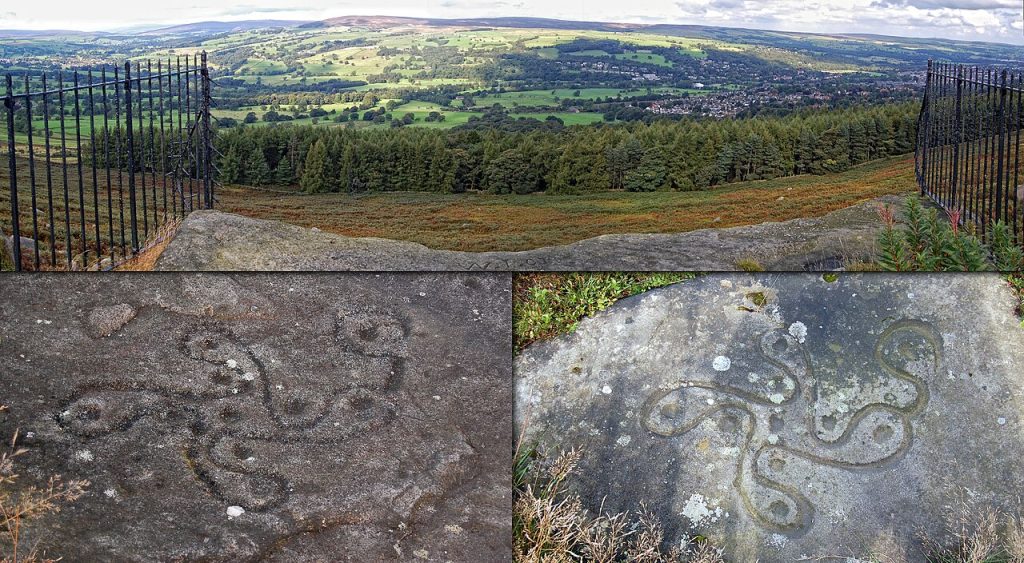
Some walks from Ghyll House Campsite are all about the view. This one is about a mystery. High on the northern edge of Ilkley Moor, a few miles from the campsite, sits a carved rock that has puzzled people for well over a century – the Swastika Stone. It makes one of the most intriguing half-day walks you can do straight from your tent, and it comes with a story that reaches back thousands of years.
The walk from the campsite
It is roughly three miles each way along the top of the moor, so allow a half day and take your time. The ground is rough, open moorland in places, so walking boots, a waterproof and an Ordnance Survey map (Explorer OL21, South Pennines) are well worth having – there is no shelter or facilities once you are up on the tops.
From Ghyll House on Addingham Moorside, follow the lane and pick up the path that climbs onto Addingham High Moor; the Millennium Way waymarkers help you find the line. Once you are up on the moor edge, turn east and follow the clear path along the top, keeping the dry-stone wall and the wooded cloughs down to your left. Along the way you pass Piper’s Crag Stone, another of the moor’s ancient carved rocks.
After a couple of miles along the tops you reach Woodhouse Crag, where a low iron railing marks the Swastika Stone itself. One quirk worth knowing: the carving you can see most clearly is actually a Victorian copy, cut into the rock beside the original in the 1880s so that visitors could make out the design. The genuine carving is just beyond it, and is now very faint.
To get back, the simplest option is to retrace your steps along the moor – it keeps you off the roads and hands you those Wharfedale views all over again.
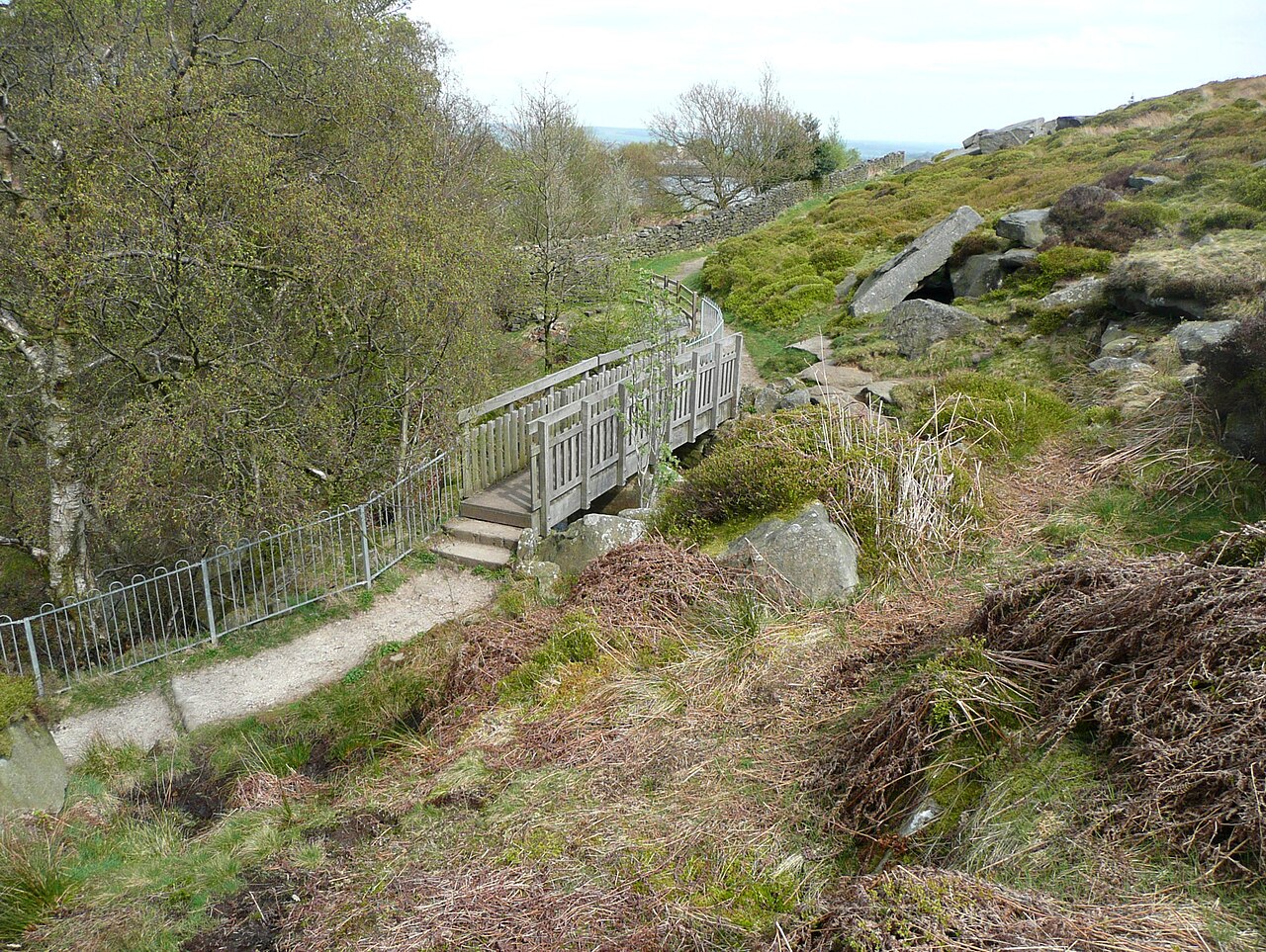
If you have the legs for it, though, Heber’s Ghyll is well worth a look while you are up here. It lies a little further east of the stone: a steep, wooded valley where a lively beck tumbles down over a series of small waterfalls, crossed and re-crossed by wooden footbridges. The Victorians adored it, laying out the paths and bridges as a romantic woodland walk, and it remains a lovely one today. The ghyll drops towards the edge of Ilkley, so it works best as an out-and-back detour from the moor – or as a finish if you have someone to collect you in town.

A note for dog owners: the moor is wonderful for dogs, but please keep them close. Spring and summer bring ground-nesting birds, and there is grazing livestock out on the open moor.
What is the Swastika Stone?
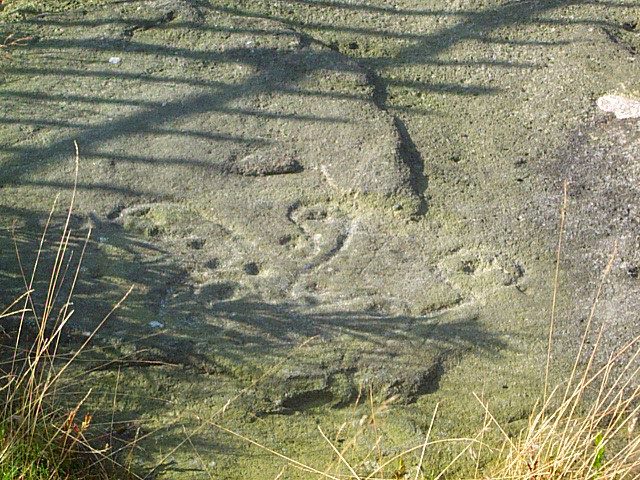
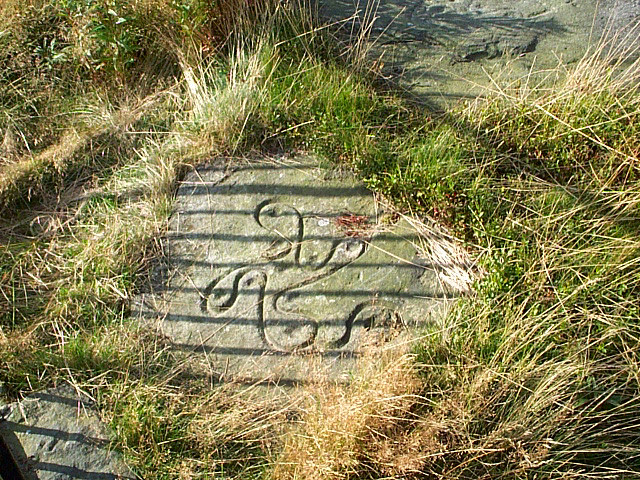
The carving has a double outline with four curved arms and an extra S-shaped tail, each loop enclosing a small hollow known as a “cup” mark. It sits among the cup-and-ring marks scattered across this part of Ilkley Moor – some of the finest prehistoric rock art in the country.
_-_geograph.org.uk_-_48281.jpg)
Nobody knows exactly how old it is. The stone has never been securely dated, but most archaeologists place it in the Neolithic or early Bronze Age – somewhere in the region of four to five thousand years ago. The archaeologist Frank Elgee took a different view, arguing the design looked more like late Iron Age work. Either way it is ancient, and it is protected today as a scheduled monument.
_-_geograph.org.uk_-_48282.jpg)
The “swastika” name only arrived around 1880, when the resemblance was first pointed out; the protective railings came later.
A symbol far older than its reputation
To modern eyes the shape can be startling, so it is worth saying plainly: the swastika is one of the oldest symbols humanity has, used for thousands of years across many cultures as a sign of the sun, good fortune and eternity. The carving on Ilkley Moor has nothing whatsoever to do with the political movement that adopted and disgraced the symbol in the twentieth century – it predates that by thousands of years.
Echoes around the world
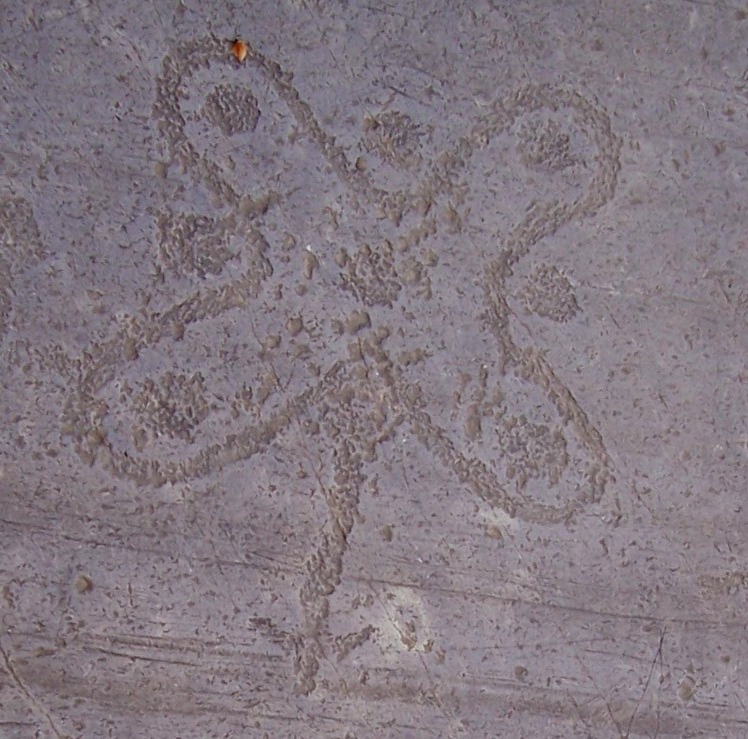
The Ilkley carving is not alone. Its closest cousin is the Camunian rose of Val Camonica in northern Italy – a single looping line that winds around a cluster of cup marks, sometimes forming a swastika. Carved in the Iron Age, it is now so emblematic of the area that it appears on the flag of the Lombardy region.
.jpg)
Turning, four-armed and spiral motifs like these crop up independently right across the ancient world: in Bronze Age Europe, in Mycenaean Greece (where the repeating form became the familiar “Greek key” border), and in Armenia, where the arevakhach stood for eternity. One of the oldest of all is a swastika pattern carved on a little bird figurine from Mezine in Ukraine, thought to be around fifteen thousand years old. That the same simple, turning shape appears in so many far-apart places is part of what makes the Ilkley stone so quietly remarkable.
Make a day of it
Pack a flask and a bit of lunch, set off in the morning, and take the walk slowly – the views across Wharfedale are reason enough to go even before you reach the stone. Then it is back to the campsite and the fire pit to warm up. And if you would rather wake up already out on the moor, our glamping teepees are the cosiest way to do it – book your stay.